22 August 2015
Loham
08 August 2015
Review of Ayaal Njanalla
20 July 2015
Review of Love 24x7
17 July 2015
Sreebala K Menon Interview
*The edited version as it appeared in Rediff. Felt something amiss there, so, posting the whole thing here.
07 July 2015
Two short films
Last week I saw two short films; eerie, dark and somewhat funny. Do have a look.
Ramaniyechiyude Namathil
Thank Ajit Yohannan for sharing the above one.
Bloody Moustache
You can read more about the Bloody Moustache here.
Enjoy!
18 May 2015
Review of Nee-Na
21 April 2015
Margarita With A Straw
07 October 2014
Review of Tamaar Padaar
12 March 2014
Organised Medical Profession and a Few Loose Cannons

25 December 2013
Heard At Last
It is a story of a little blind girl who lives by coalescing the world inside her head and the world outside. Yes, it does helps to have a world inside your head if you’re stifled by a disability, so, if you feel you are ignored in the real world, you can be happy inside your head. The only thing you’ve to be careful about is that you don’t end up with schizophrenia (pun intended). I remember being a cricketer to a pilot flying my own plane sitting in a corner (where there was least chance of me getting hurt), while other kids were busy playing.
The sound of this video is on the lower side. So, it would be better if you download it and play it using VLC Player with high volume.
PS: I’d messaged Geeta when the news of the Liar’s Dice making it to the competitive section of the Sundance film festival had started trickling in saying that I’d like to see it if there was any preview show in Kochi and even Kelkunnundo? In her reply she mentioned that Kelkunnundo? is available online.
01 December 2013
Disabling Imagery
09 June 2013
The Untitled Kartik Krishnan Project
21 September 2012
Age and wisdom: residue of a review – a strange connection between Chattakari and Run Baby Run
13 May 2012
Interview with director Arun Kumar Aravind
29 July 2011
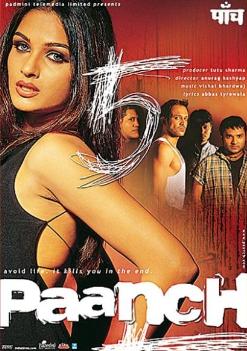
Paanch – not a formal review

At last I watched the full version of Paanch directed by Anurag Kashyap (a dear friend had sent a torrent link). All these days I’d seen only bits and pieces of it fearing an overdose of violence. It is the censored version with Adult certificate. I don’t understand what was the fuss all about for censors to block it all these years as more grotesque and sleazy stuff was passed without any qualms (Govinda-Karishma Kapoor were ruling the roost during that period if I’m not mistaken).
It isn’t a great film by any stretch of imagination (especially if you have seen Last Train to Mahakali and the avant-garde No Smoking). Here you feel the director seems to have begun the film with I wanna shock you attitude as you hear words daru, dum, stoned and few other synonyms of intoxication thrown in and even few expletives in Hindi and English.
The dark story of five struggling rock musicians going on killing spree in order to make money for decently recording demo album, which by the end becomes the story of a psychopathic freak Luke played by Kay Kay.
Kay Kay seems to be very frigid for the role. He is good in non performing (as a musician/stage performer) parts. But, the agility required a performer is missing (we just get a glimpse of it when he is shown climbing the flight of stairs running in the beginning).
The ultimate winner here is Abbas Tyrewala, the lyricist. I smile whenever I feel like scratching my …… Ghin Aati hai Khuja Mat :-P
12 January 2011
Interview with Director Ranjith Sankar
Now, he is ready with his second film Arjunan Saakshi, which is releasing on 28th of this month. I mailed him a few questions and he replied; here I'm posting them.
How has Arjunan Saakshi shaped up? Now that shooting is over and you're into post production, are you happy what you're seeing on the Avid Machine, so to speak?
I am happy with Arjunan Saakshi when I see it now. It has shaped up more or less the way it was perceived. Thanks to all my actors and technicians who made it happen. Arjunan Saakshi is a result to good team work.
This is your second film and there seem to be lot of expectations, does that make you nervous or inspire you? Or to put little differently, How was the experience of making Arjunan Saakshi different from making Passenger?
Not nervous. But excited a bit to see how people react to AS.
AS was more responsible I must say. There were actors and technicians coming into the project since they believed in me. Also AS is more a “proper” commercial film in that aspect.I got to work with a stunt master and dance master. I made passenger in 38 days. AS took us 43 days. It was worth it looking at the technical finesse we have achieved.
You had spent lot of time with the script of Passenger before you could see it being actually made, but Arjunan Shakshi obviously took lot less time to fructify (even though the idea was in your head for many years), did you do anything differently while writing it or approaching actors?
Nothing. Actually for AS it was more easy since actors were willing to work with me even before a script was discussed. So I had to make sure I got my priorities right and get the most appropriate people for the parts. What I always felt it once you are convinced of the story its easy to convince anyone for that matter.
You continue to be software engineer even after becoming a successful filmmaker, how easy or though is carrying both worlds inside you? Do these worlds overlap sometimes?
At times yes,especially during the shooting days J. I am able to manage since I have a supportive management at office. I don’t plan way ahead. So happy the way it is now.
Here is another elaborate interview done by my friend Veeyen
Trailer of the film:
05 December 2009
Discovered John Malkovich and Reread Disgrace

14 August 2009
Review of Malayalam film Ritu

02 November 2007
No Smoking – In defence of Anurag Kashyap
Now, I feel I have got an appropriate film in No Smoking to write about. My only interest in this film until a few weeks ago was that couple of my Net friends from this Community blog were partly involved with this film. But, when I started hearing the songs a few weeks ago I virtually started feeling aroused (ha ha ha) to see it.
The film released last Friday (just two shows here), I’d made plans to see it on Monday due to circumstances (but a friend cursed me that I’ll not see the film without her and it rained; on Tuesday I cursed her back and made it without her).
By Saturday evening the film had received royal drubbing from all and sundry, main stream media as well as blogs, even the Community blog where Anurag Kashyap himself writes has not spared him, which created doubts in me whether to take the effort to watch it in the theatre or wait for the DVD release. My Net friend didn’t help things as his reply to my sms was something like: See it in the theatre itself. I personally found it long, boring & was lost by the end.
I loved this film is to put it mildly. I found the film had lot of parallels with my life though I’m a non-smoker by limitations and not by choice (wish I could bring up a few examples while writing this).
I have no idea about homage being paid to Kafka or who Bob Fosse is as is repeatedly mentioned in the reviews or that it is inspired by a Stephen King short story.
For me the film was how a community is ostracised by the so-called politically correct society. They should be reprimanded. They should be stopped. They should be rehabilitated. It somehow succeeds in doing that by the end.
I am always being advised to sit straight, not to keep my head tilted: It makes you look retarded or you should talk properly to prove that you are intelligent. Recently only I have found the courage (at least with some people) to say that the way I do things because I find it easier do them and if the salesman at the music shop thinks that I’m a dumbo and doesn’t treat me well because I take your help to communicate with him, it is his loss not mine; somewhat like John Abraham rudely tells the old lady to take the stairs when she is irritated by his smoking in the elevator.
We all know cigarettes kill. Nicotine is addictive. Then why not bring in stringent laws so that people who have grievance and those who are feeling cheated can milk the conglomerates that make these Cancer Sticks dry by the rule of Law.
Here is an intelligent review of Baradwaj Rangan and here is why I’ve started losing respect for initial Guru in film appreciation.
And a pro-smoking post by BG.
PS. A warning to people who get dosage of advice from me to reduce the intake of nicotine: if you ever use this post as an argument against me, I’ll kick your b….s. Smoking leads to impotence. Understand Yaar!
20 January 2007
Second take on Thanmatra
So, if the director had aimed to create awareness about the disease, which can be easily misinterpreted as forgetfulness, he has succeeded at a very basic level, first in describing the illness and later in detail by showing us what a person has to suffer and what his family has to go through when this happens.
And, if the suffering person happens to be an ideal son, husband and father, then the impact on the audience will be immense.
Meet Ramesh Nair (Mohanlal) a personification of above-mentioned qualities – a middle-level employee in the State Secretariat, who in his younger days aspired to be an IAS officer in his younger days as per the wishes of his father, but has now pinned his hopes on his teenaged son Manu (Arjun).
Manu basks in the reflected glory of his father’s knowledge as he presents a project on innovative learning techniques in his school’s science club. These techniques are taught by his father. His father is also invited to PTA meet to counsel other parents on varied subjects like personality development to bringing up children to memory improvement.
Ramesh massages his father’s legs with herbal oil when he visits ancestral home in the village. He also cooks with him reminiscing the good old days.
Being an ideal husband may come easy for such a person; Ramesh dotes on his wife, his past failures and past relationship never coming in the way.
Now if such a person has this depleting disease, what he or the people around him will go through? In the beginning there will be confusion, then shock, some anger, at last acceptance and the courage to face what life has given you.
Initially we feel that the director is trying to spoon feed us about the details of Alzheimer’s as we are shown the hero elaborating the intricacies of it in voice over as if he is explaining to his son. He says it is as if the waves receding into the sea or as if the brain has started reverse counting slowly taking back all that we have learnt; taking us back to our childhood and ultimately towards death or words to that effect. This happens after Ramesh is diagnosed with pre-senile Alzheimer’s and the doctor saying that it is the caregiver who needs the treatment/support and not the patient. The docudrama style of narration even has the mention of Roland Reagan as one of the famous persons who suffered this disease.
But Blessy wins with the script (he got the State Award as the scriptwriter and for direction, in all ‘Thanmatra’ garnered five State awards). He loops it in such a way to show the complete turnaround of the character of protagonist. It begins with simple things as he cannot remember the pet name of his childhood beloved and the words of his favourite Bharathiar song. Then it moves on to frustration and anger on misplacing an important file. At last creating a scene in the office thinking that it is home, this leads to his hospitalisation and diagnosis.
The rest of the incidents in the film go on show the reverse counting of the brain; Ramesh’s condition deteriorating with him behaving as a child. The contrast in the pre-intermission and post-intermission personality of sometimes becomes unbearable; especially when we see him lying dead in a foetal position in the end with a dishevelled look on his face because once we remember him chiding his wife to wear her Sari properly telling her that his mother used say that you should be made up even if you are lying dead. It signifies that the person has lost everything he stood for in his life.
There are some points in this film where the use of cinematic licence goes overboard. One, the nuclear family is picture perfect, how come there are no differences of opinion or minor fights? Here the head of the family is an all-knowing demigod. Here the son follows his father’s diktats without slightest opposition or grudge and the daughter is too young to have an opinion.
Second, the doctor just pacifies Ramesh, (when he goes to him for the first time worried about his memory lapses), saying that he may be having an anxiety syndrome because his son is appearing for Board Exams. In this day and age when even a minor migraine is looked at with utmost seriousness by medical professionals this kind of response is least digestible (or is that they wanted to show that the doctors may also fail to notice the symptoms initially).
In conclusion we can use a quote by Nobel laureate Saul Bellow that "Everybody needs his memories. They keep the wolf of insignificance from the door." In ‘Thanmatra’ director poignantly shows what can happen if that wolf enters our home.
(A slightly edited version of this appeared in the Oct-Dec 2006 issue of Success & Ability. I had written a review of it earlier and also interviewed Blessy. Here I have tried only to focus on Alzheimer’s disease).